Walking Onions: The Onions That Just Keep Walking
I often get asked, “What are those strange things growing in your garden?”
The answer: walking onions.
I have been growing them for so long that I honestly don’t remember where they came from or where it all began. You see, once you have walking onions, you always have walking onions. They are amazingly prolific.
The scientific name for these onions is Allium cepa × proliferum. Once you grow them, you won’t need to know much Latin to understand why they earned the name proliferum. These onions have many variants. All of them fall under the name Egyptian Walking Onion.
I have to admit, I don’t know exactly where the “Egyptian” part of the walking onion comes from. Maybe they originated in that part of the world. Maybe there is a connection to ancient Egypt or even Egyptian tombs. Do you know? If you do, I’d love to hear about it!
These unusual onions go by many common names: Tree onion, Top-set onion, Winter onion, Perennial onion, Medusa onion, Snake onion, and Catawissa onion. And, as it turns out, there is a story behind every one of those names.
Tree Onion
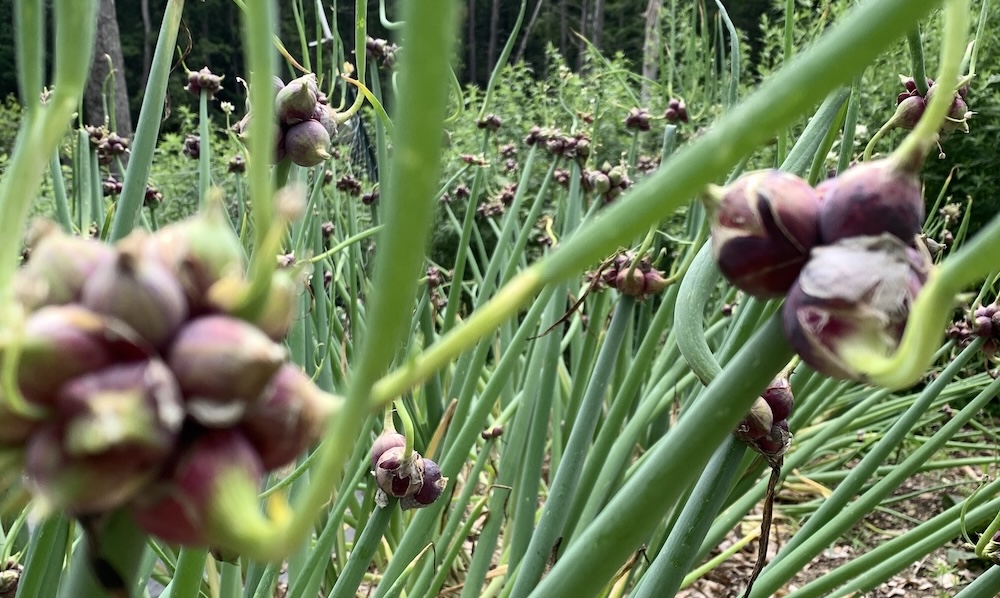
“Tree onion” makes a little more sense when you see how these plants grow.
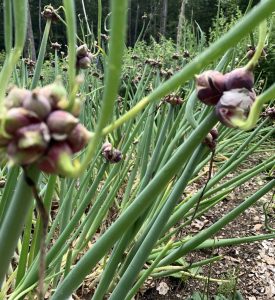
Walking onions produce their little onion bulbs, or top sets, at the top of the leaf stalk. Sometimes they produce them in layers. I have had three levels of top sets growing on a single plant, hence growing like a ‘tree’.
Top-Set Onion
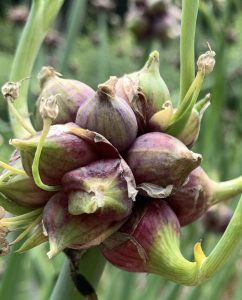
This name is pretty straightforward. Instead of relying on seeds, walking onions produce top sets—small bulbs, or bulbils, at the top of the stalk. These can be eaten or planted to grow new onions. That is one of the ways these onions multiply.
Winter Onion
This one is easy to understand. Walking onions are very hardy. In my Zone 5 garden, they grow and overwinter outside through snow, freezing temperatures, and all the other joys of a New England winter. They can even overwinter outdoors in pots.
Perennial Onion
Again, pretty straightforward. Walking onions come back year after year, which is why they are often called perennial onions. Of course, they aren’t the only perennial onion—even in Zone 5. But that’s a topic for another blog.
Medusa Onion and Snake Onion
You only have to see a walking onion when producing its top sets to understand these names. The stalks begin to bend and twist under the weight of all those little bulbs. Some plants look a bit like a mass of snakes or the head of Medusa. Once you see one, you’ll understand.
Catawissa Onion
This name was a surprise to me. The Catawissa onion is believed to have originated around Catawissa, Pennsylvania, a town I lived next to for nine years. No, I didn’t get my walking onions there!
Which Walking Onion Do I Grow?
There are several types of Egyptian walking onions, including Catawissa Red, Missouri Red, McCullar’s White, Brown Catawissa, and Heritage Sweet White.
Now you’re probably going to ask: Which one do I grow? Well, your guess is as good as mine!
What I do know is that there are differences among the white, red, and brown varieties. I currently grow the brown or red type—at least for now. As for which specific brown or red variety? I honestly don’t know. Some of mine look brown, while others look distinctly red to me. So, for the moment, I’m calling them walking onions and leaving it at that.
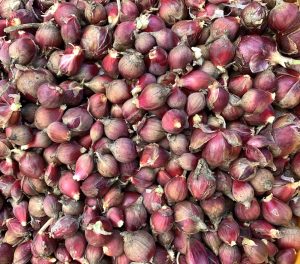 Top sets
What I can tell you is that they taste much like traditional bulb onions, but they are far easier to grow. And you can eat them year-round. What more could you ask for?
How to Plant Walking Onions
If you purchased certified organic walking onion top sets from Terra Basics, you can put them right into the soil.
But before you do, there are a few things to know. Walking onions can be planted in a vegetable garden, flower garden, or container. They actually make an interesting addition to a flower bed because of their unusual shape and visual texture.
And yes—they grow very well in pots.
Planting in a Garden Bed
Choose a location that receives full sun—at least six hours of direct sunlight a day.
Walking onions prefer soil that is:
- Loose
- Rich
- Well-drained
- Not consistently wet
Choose the location carefully because this is a plant you can expect to have for years. Once established, walking onions come back year after year and will continue to multiply.
They will grow in less-than-perfect soil, but if you want large, healthy plants and plenty of onions, give them a good start.
I like to prepare the bed with compost and wood ash. Wood ash can provide potassium (potash), calcium, and magnesium, and it can also raise soil pH. This can be helpful in New Hampshire, where soils are often acidic. That said, don’t add wood ash simply because you can. A soil test is the best way to know what your soil actually needs. Soil tests are relatively inexpensive and can provide useful information for improving your garden soil.
Preparing the Bed
Loosen the soil before planting. I use a broadfork, but a garden fork works just as well. A shovel will also do the job if that’s what you have.
If you are converting a grassy area into a garden bed, you will have a little more work to do. Remove the sod and as many perennial weeds as possible.
Then add plenty of good compost. Compost helps improve soil structure while adding organic matter that supports healthy plant growth.
Planting in a Flower Bed
Walking onions can be surprisingly attractive in a flower garden.
Give each plant about one square foot of space. This is a little more room than they need in a vegetable garden, but it helps keep them from being shaded by surrounding flowers and perennials.
Walking onions can eventually reach 2–4 feet tall, so place them where their height won’t become a problem.
It may take a year or two for them to really begin expanding, but once they do, they will.
Depending on your climate, the foliage may die back to the ground in winter. Don’t worry. They’ll be back in early spring.
Growing Walking Onions in Pots
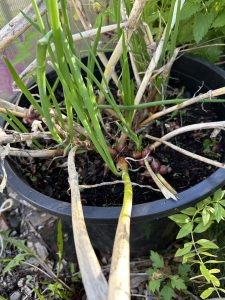
Don’t have a garden? A pot works beautifully.
Start with a 6-inch pot and plant three top sets. Use a good-quality potting mix or garden-bed mix.
For larger pots, you can increase the number of bulbs as the pot gets larger:
- 6-inch pot: 3 bulbs
- 8-inch pot: 4 bulbs
- 10-inch pot: 5 bulbs
In other words, add roughly one bulb for every two inches of additional pot diameter.
It might look a little lonely when you first plant them. Don’t worry. They will multiply.
Walking onions can live outdoors in pots year-round. I have not had much luck bringing them inside to overwinter, so I simply leave mine outside.
In spring, put the pot in the sunniest location you have, and they’ll begin growing quickly.
In fact, walking onions are one of the first signs of spring in my gardens.
Each year, top-dress the pot with a little fresh compost or potting mix to replenish the soil.
Planting the Top Sets
This is probably what brought you to this blog in the first place!
Plant each little top set about one inch deep and space them 5–6 inches apart.
That’s it.
Now sit back, have a cup of tea, and let these little powerhouses do their thing.
The ‘Walking’ Proliferator
This is where walking onions get really interesting. They don’t reproduce from seed.
They walk! Not really, but it seems that way. Let me explain.
When the topsets, sitting on the very top of the onion leaf, get heavy enough, they fall over, reaching 2-3 feet from the original plant. If they touch the ground, they will start a whole new plant or two or five!
Once the topsets mature and turn brown or red—usually around August—they can be broken off and planted where you want them to organize the chaos of the walking.
And that’s only one way they multiply.
Like Shallots, once walking onions are established, they produce multiple bulbs underground, particularly in their second and subsequent years. This will happen in the fall after the topsets are done being produced.
The result? More onions.
And more onions.
And more onions.
You get the idea.
Harvesting Walking Onions
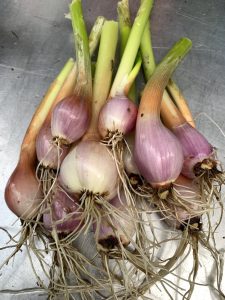 Ground bulbs
One of the best things about walking onions is that almost the entire plant is useful.
The green tops can be harvested from spring through fall and used like green onions. There is a point in the growing year, usually August in my neck of the woods, where the Topset are set, but not yet complete. The stalks will start to dry. The leaves are not tasty, but the onion can be pulled and the topsets or ground bulb eaten. The underground bulbs can be used fresh or cured and stored for winter, just like other onions.
And don’t forget the top sets!
The little bulbs produced at the top of the stalk are edible, too. They are small, which makes them especially useful in soups, stews, sauces, pickles, and brines. These onions can be eaten throughout the year.
A Note About the First Year
If you have just planted walking onions, I recommend leaving the underground bulb alone during the first full year of growth.
Let the plant establish itself.
You can harvest the top sets and use them to expand your planting area, but give that first underground bulb time to settle in and grow.
By the second year, you can begin harvesting the green leaves as green onions.
In early spring, pull a few plants—not all of them—or simply break off some of the green leaves and leave the bulb in the ground to continue growing.
Later in the second year, after you’ve collected the top sets, you can harvest some of the underground bulbs and cure them for winter storage.
But always leave at least some plants behind so they can continue to multiply.
After all, that’s what walking onions do best: multiply.
Transplanting and Dividing
By the second year—and especially in subsequent years—you may notice that your walking onions have become crowded.
You’ll see many stems growing from one cluster.
That’s your signal that it may be time to harvest, divide, or transplant.
Fall is an especially good time to transplant them.
When the plants become overcrowded, they may produce smaller underground bulbs and fewer or smaller top sets.
Simply dig up a clump, separate the bulbs, and replant them with enough space to grow.
And then let them get back to what they do best:
Making more walking onions.
Once you plant them, you may never have to buy onions again.
And that’s a pretty good reason to make room for a few strange-looking plants in the garden.